Slips, Trips & Falls on the Job: The Causes & Prevention
- By Layer5 Solutions
- Aug 18, 2020

Slips, trips, and falls make up a staggering portion of workplace injuries and deaths. Here, we talk about how common they are, and some methods for preventing them.
Data on Slips, Trips, and Falls at Work
According to the Liberty Mutual 2020 Workplace Safety Index, workplace injuries cost businesses $59 billion per year. Falls on the same level are responsible for $10.9 billion of those costs. Falls to a lower level are responsible for another $5.7 billion. Slips and trips without a fall make up still another $2 billion. On average, each injury from slips, trips, and falls results in 12 lost workdays. Falls to a lower level are more dangerous and average 18 days of lost work.
Nonfatal Injuries
Slips, trips, and falls are some of the most common causes of injury in the workplace. According to the Bureau of Labor and Statistics, they caused 240,000 out of the 900,000 nonfatal injuries that took place in 2018.
If you’re in the service industry, you might think injuries are less of an issue for you than in manufacturing, but the reality is that out of those slips, trips, and falls, 190 thousand happened in the service industry, while only 50,000 occurred in the goods production industry. Within goods production, most slips, trips, and falls happened in the construction and manufacturing industries, with 22,000 and 24,000 in each of them respectively. Natural resources and mining still saw 5,600 injuries from them.
Within the service industry, trade, transportation, and utilities saw the most slip, trip, and fall related injuries at 74,000. Education and health services came next at 47,000. Leisure and hospitality were responsible for 29,000, professional and business services for 20,000, financial activities for 8,300, and information services for 4,300. Needless to say, no matter what industry you’re doing business in, slips, trips, and falls are an issue you need to be prepared for.
Fatal Injuries
Fatal slips, trips, and falls are much less common, but the BLS data is still concerning, and businesses in any industry should take extra precautions to prevent deaths from these kinds of accidents.
In total, there were 791 deaths from slips, trips, and falls in 2018. Nearly all of them, 744, took place in private industry. Unlike injuries, more deaths occurred in goods production, which was responsible for 426 deaths, 338 from construction. The service industry certainly isn’t immune, however, accounting for 318 of the deaths from slips, trips, and falls. Of these, 110 took place in the trade, transportation, and utilities industry. There were 109 deaths in professional and business services, mostly from administrative and waste services which was responsible for 95 of them.
The remaining deaths are scattered throughout all industries and it’s important to keep in mind that no industry is immune. A closer look at the type of fall reveals that most fatalities happened where workers fell from one level to another. The fatalities that occurred on the same level were almost entirely the result of slips and trips.
Slip, Trip, and Fall Prevention
Preventing slips, trips, and falls starts with being Osha compliant. Osha’s requirements for Walking-Working surfaces apply to all industries. We can’t cover everything here, but we will cover some of the most important requirements.
General Requirements
For starters, all walking-working surfaces need to be kept safe. That means everything needs to be kept clean, orderly, and sanitary. Keep floors dry to the extent possible. When it isn’t possible, drainage, false floors, platforms, and mats must be used to keep the area safe. Hazards like sharp or protruding objects, loose boards, corrosion, leaks, spills, snow, and ice need to be kept off of the floor.
All walking-working surfaces need to be designed to support the maximum weight those surfaces will ever see. Entrances and exits to all working surfaces also need to be kept safe, and employers need to ensure that workers are using the proper entrances and exits.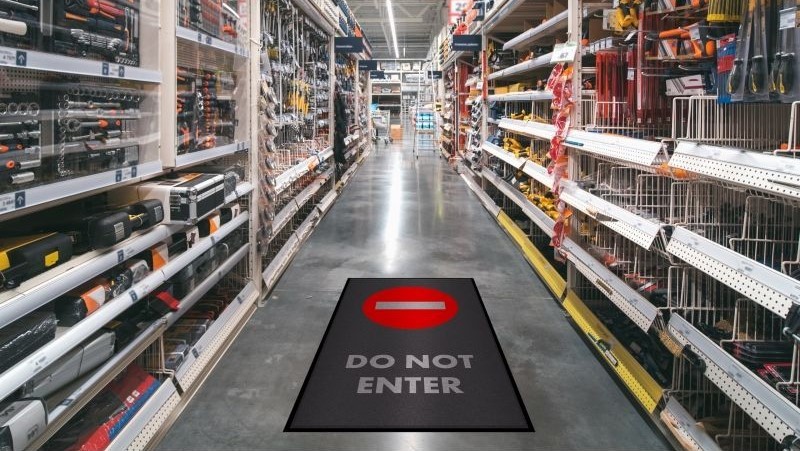
Regular inspection, maintenance, and repair is also crucial. Any hazardous floor conditions need to be taken care of before employees are allowed to use the area. When it can’t be taken care of right away, the area needs to be guarded. If the surface is damaged or structurally compromised, an expert needs to either perform the repairs or supervise them.
Ladders
- Ladder rungs or steps need to be evenly spaced, parallel, and level with the ground. Each type of ladder has specificing spacing and size requirements that need to be met.
- Wooden ladders shouldn’t be painted or coated in a way that would hide defects.
- Metal ladders should be made from corrosion resistant materials.
- The ladder surface shouldn’t have any laceration or puncture hazards.
- Ladders should be inspected at the start of each work shift.
Stairways
Here are some of the most important OSHA guidelines for stairs.
- Stairways need handrails, stair rails, and guard rails.
- No overhead obstructions within 6 feet 8 inches.
- Uniform steps
- Landings and platforms need to be as wide as the steps and at least 30 inches deep with room for doors
- Stairs should be built to support five times the expected load and a minimum of 1,000 pounds.
Various more specific requirements are in place for standard, spiral, ship, and alternating tread stairs.
Fall Protection Requirements
OSHA requires that these steps be taken to prevent falls and falling objects.
- If a surface has an edge with a fall more than 4 feet, it needs to be protected with guard rails, safety nets, or personal fall protection like a harness. If that isn’t feasible, an OSHA compliant fall protection plan needs to be in place.
- Likewise, hoist areas need to protect employees from a fall of more than 4 feet with a guardrail, personal fall arrest system, or a travel restraint system. The guidelines are the same for holes except that covers can also be used.
- Dockboards need to be protected with guardrails or handrails, unless in use by trained employees using motorized equipment who aren’t at risk of falling more than 10 feet.
- Runways and similar walkways need to be protected with a guardrail. If it isn’t feasible, a trained employee using a personal fall arrest or travel restraint system is acceptable.
- Falls into dangerous equipment need to be protected against using a guardrail or travel restraint system.
Training Requirements
- Employees that will be exposed to fall hazards need to be trained by a qualified person
- Employees also need to be trained in equipment to protect against falls
- Rigorous retraining standards need to be in place
- Training needs to be easy to understand
Non Slip Mats Can Help Reduce Injuries On The Same Level
While most of the discussion in OSHA guidelines focuses on falls from one platform to another, the reality is that most falls are slips and trips that happen on a single level. And slips on wet or slick surfaces are among the most common causes. To prevent tracking of rain or snow from outside throughout the building, it is recommended that businesses put at least 15 feet of matting in place. This not only prevents tracking liquid, but debris that can contribute to slipping or tripping.
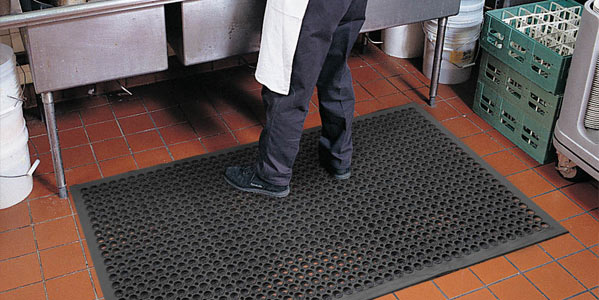
Anti slip mats are required in any workplace where liquids are expected. They are also recommended anywhere where workers will be regularly shifting their weight and require good traction, including anything from food processing to welding. Oil resistant mats are especially important around heavy machinery or around cooking oil. Anti slip mats can also help reduce fatigue in workers who need to stand in place for extended periods of time since less energy is needed to keep balance and less strain is put on the feet and legs
Shop Anti-Slip Mats
-
 Razorback™ with Dyna-Shield®
Foam anti-fatigue corrugated surface with highest wear and strength
Model No:
406
Starting at
$ 14.00
Razorback™ with Dyna-Shield®
Foam anti-fatigue corrugated surface with highest wear and strength
Model No:
406
Starting at
$ 14.00
-
 San-Eze® II
Top-of-the-line Cadillac grease resistant red restaurant kitchen mat
Model No:
T11
Starting at
$ 84.00
San-Eze® II
Top-of-the-line Cadillac grease resistant red restaurant kitchen mat
Model No:
T11
Starting at
$ 84.00
-
Razorback™ with Dyna-Shield®Foam anti-fatigue corrugated surface with highest wear and strengthModel No: 406Starting at $ 14.00
-
San-Eze® IITop-of-the-line Cadillac grease resistant red restaurant kitchen matModel No: T11Starting at $ 84.00