Safety Standards for Fire-Retardant Floor Mats
- By Layer5 Solutions
- Nov 25, 2020

In heavy industry, a spark can quickly lead to a flame.
In industrial settings where metal grinding, cutting, or welding happens or where caustic chemicals are utilized, the risk of fire is always present. NoTrax® fire-retardant are geared for placement in these heavy manufacturing settings, production lines, assembly lines, near welding equipment, and at individual workstations.
Why We Need Safety Standards
Most commercial matting products don’t have to have a certification to make specific, functional claims. Mats in categories like non-slip, anti-fatigue, or static dissipating are largely unregulated.
While these products are not required to undergo testing, there are recommended levels of design and performance guides from agencies like The American National Standards Institute (ANSI), and the National Floor Safety Institute (NFSI).

There is a base level of consumer trust given to your organization when your products adhere to the guidelines set by notable agencies. However, when a product claims fire-resistance, fire-retardant, or ant-fire capabilities, it is subject to additional federal oversight and testing. This additional oversight insures organizations aren’t marketing subpar products that could have potentially deadly ramifications if they were to fail, and, unlike the guidelines, these are not optional.
What are the Safety Standards for NoTrax Anti-Fire Mats?
NoTrax fire-retardant mats are put through three tests that conform to OSHA, ASTM, CPSC, and NFPA guidelines.
Flammability NFPA Guidelines
The National Fire Protection Agency (NFPA) and the Consumer Product Safety Commission (CPSC) have their own set of federally required guidelines for anti-fire matting products. The NFPA guidelines require a flame test via the CPSC using a small pill that ignites for approximately three minutes. To pass the test and gain certification, the mat must self-extinguish the fire.
There are no increments of success with this test – it is pass or fail.
Critical Radiant Flux
Critical radiant flux measures the distance of a burn up to the point the mat self-extinguishes. The burn length is converted into watts-per-square-centimeter (watts/sq cm). The higher the watts/sq cm value, the better the fire-retardance.
Products with critical radiant flux values are separated into classes. Class 1 products have a watts/sq cm value of 0.45 and higher. Class 2 products have a value of 0.22 to 0.44 watts/sq cm. NoTrax mats like the Cushion-Ease® Niru® Solid Fire-Retardant Floor Mat are Class 1 products.

Static Coefficient of Friction
Coefficient of Friction (COF) testing measures the force required to slide your foot across the mat. This determines the anti-slip functions of a mat. COF values are set between zero and 1. The lower the value, the more slippery the mat; the higher the value, the less slippery.
But there’s a catch. Mats with a COF of 1 mean your feet won’t scoot across the mat and it becomes a trip hazard. A COF of zero and your foot encounters no friction and will slip easily. The Occupational Safety and Health Administration (OSHA) recommends a COP of 0.5 in dry areas and 0.25 in areas where moisture is prevalent.
Benefits of NoTrax Fire-Retardant Matting Solutions
NoTrax engineers its anti-fire products from fire retardant rubber. Our rubber is chemically treated to be slow burning or self-extinguishing when exposed to an open flame to reduce workplace accidents and help limit their severity.
Popular NoTrax anti-fatigue matting solutions like Cushion-Ease® and Skymaster® are available in fire-retardant configurations. In addition to anti-fatigue options for industrial workspaces, NoTrax also offers military-grade fire-retardant switchboard Type 2 and Type 3 matting solutions.
-
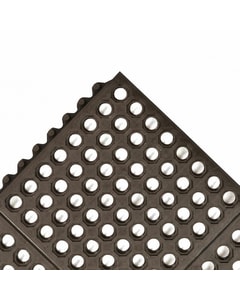 Niru® Cushion-Ease® FRInterlocking fire retardant nitrile rubber provides ergonomic supportModel No: 650SFRAs low as $ 135.00
 -
 Military Switchboard Type 2Smooth surface, fire-retardant and electrically insulating floor matModel No: 835As low as $ 33.00