


Commercial buildings can be anything from retail businesses to a doctor’s office. The one thing that all commercial properties have in common is people traffic. Because the entrance ways, lobbies, or foyers of commercial buildings are often bustling with foot traffic, they can also quickly become dirty places.
Patrons or vendors can track dirt or debris from the outside into a building’s lobby causing it to look unclean. On rainy days, people shuffling in and out can cause a building’s lobby to become slick and potentially dangerous. Fortunately, there is a simple solution that can help keep a commercial building’s entrance way or lobby safe and clean: an entrance mat.
Entrance mats provide traction to help reduce slips and falls, trap debris before it gets into a building, and protect floors from being damaged. There is a wide range of mats that can be used in building lobbies, entrance ways, and foyers. Finding the right mat depends on the primary function(s) that the mat will perform and in what specific context.
Here is a breakdown of some of the most common features of entrance mats to help you find the mat that is right for you.
Features of Indoor Lobby Floor Mats
Indoor mats will help to protect floors and people from water, snow, mud, or debris that is tracked inside. NoTrax® offers a wide range of indoor mats with various features and designs. Understanding the benefits of these features will help you determine what kind of mat is best suited to your needs.
Mats with Non-Slip Surfaces
One of the features of a reliable entrance mat is that it provides a non-slip surface. Carpet entrance mats—like the Heavy-Weight Scraper Entrance Mat Heritage Rib™ 117—offer anti-slip traction as well as moisture retention designed to absorb water. The Scraper entrance mat features a Heritage Rib double rib high/low design that scrapes off the debris and has 33% more carpet than many competitors’ “best” rib mats.
Rubber entrance mats are also ideal for providing a non-slip surface. Rubber mats—like the Scraper Outdoor Brush Mat, Rubber Brush™ 345—are manufactured with SBR rubber that is highly flexible and resistant to extreme cold. A rubber mat is designed to trap debris using thousands of tiny, rubber fingers that scrape dirt and other debris off the bottom of shoes. The beveled edge around the perimeter of the Scraper Rubber Brush acts as a dam trapping moisture inside the mat to prevent water from being tracked into the lobby of a building.
-
 Heritage Rib™High performance double ribbed pattern entrance carpet mat for drying shoesModel No: 117Starting at $ 16.92
 -
 Rubber Brush™Outdoor entrance mat with flexible fingers to remove dirt and debrisModel No: 345Starting at $ 34.00
 -
 Niru® Versa Runner™Nitrile rubber runner with a slotted knob-top designModel No: 755Starting at $ 34.00
Mats with Underside Grips
Over time, entrance mats are prone to shift or slide because of heavy foot traffic. To prevent this from happening, it is important that a reliable entrance mat has an underside grip to prevent unwanted movement and keep the mat in place. Different mats have different underside grip technologies, but all mats that incorporate underside grip are less prone to shifting.
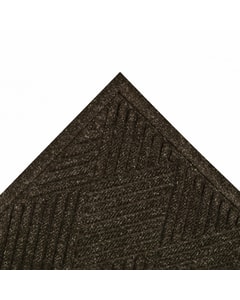
The Debris Scraper Entrance Mat Opus™ CTE™ 169 features “cleats” on the underside of the mat that grip the underlying surface to reduce movement. Some mats—like the Low-Profile Scraper Entrance Mat Brush Step® 109—feature a vinyl backing that ensures minimal buckling and mat movement, while other mats feature underside suction cups to hold the mat in place.
-
-
 Brush Step®Ribbed pattern entrance mat for cleaning the bottom of shoesModel No: 109Starting at $ 18.90
 -
Rubber Brush™Outdoor entrance mat with flexible fingers to remove dirt and debrisModel No: 345Starting at $ 34.00
-

Debris-Trapping or Absorbent Mats
Another beneficial feature of a reliable entrance mat is debris trapping and has an absorbent quality. Entrance mats typically have a rigid surface that scrapes the bottoms of shoes causing debris and dirt to dislodge and fall into the mat.
A mat like the Debris Trapping Entrance Mat Polynib™ 136 not only scrapes debris off, but its tightly nibbed loops allow it to hide debris away. Other mats—like the Moisture & Dirt Retention Entrance Mat Sabre™ 130—use olefin fibers to trap debris and retain moisture.
-
 Sabre™Entrance mat for drying shoes for light to medium traffic areasModel No: 130Starting at $ 21.00
 -
Heritage Rib™High performance double ribbed pattern entrance carpet mat for drying shoesModel No: 117Starting at $ 16.92
-
-
Rubber Brush™Outdoor entrance mat with flexible fingers to remove dirt and debrisModel No: 345Starting at $ 34.00
Recessed Floor Mats
A recessed floor mat is another option for commercial building entrance ways, lobbies, or foyers. A recessed mat is a mat that has been permanently fixed to the floor using a recess. Many recessed mats lie flush with the surrounding floor once they are installed, which means that a recessed mat—unlike a regular mat—can reduce trips or falls due to uneven surfaces.
Regular mats can sometimes slide, shift, or even become uplifted by foot traffic. Because a recessed mat is fixed to the floor, it eliminates the hassle of constantly having to reposition an entrance mat.
Recessed mats can be installed by placing them into a floor recess in a building lobby or entrance way. Mats like the Scrape & Dry Entry Mat Smart Step™ ArrowTrax® 323 are capable of being placed in a 3/8" to 1/2" floor recess and allow for a 9/16" door clearance once installed. Recessed mats do not have to be extracted in order to remove trapped dirt or debris. They can be easily cleaned using a backward rotating carpet cleaner to remove all trapped debris.
-
 Master Trax® LiteMedium traffic oversized entrance where multiple mats is not desirableModel No: 371Starting at $ 14.00
How Much Entrance Floor Matting is Recommended?
To effectively trap dirt and debris before it can enter your building, it is best to follow the 15-foot rule. The 15-foot rule says that each shoe will meet with a mat at least three times before encountering the floor of the building. The 15 feet of matting can be either a single, continuous mat or—for a better result—a series of three mats can be used.
The first zone of matting should feature a rigid surface that can trap large debris. The second zone of matting continues the scraping process by trapping finer particles while initiating moisture absorption. Finally, the third zone of matting should incorporate softer surface fibers that will complete the cleaning and drying process.

The Importance of Entrance Mats
Having an entrance mat in the lobby or entrance of your commercial building can help prevent slips and falls. Entrance mats can also ensure the longevity of the floors in your building by trapping dirt and debris before they can encounter your floors. NoTrax offers a wide selection of entrance mats designed to keep your building safe and looking great.